Traffic quality
How to Buy Adult Traffic Without Paying for Bots
Exclude proxy and IPv6 traffic before launch, then bid, cut and blacklist at the source ID level, because bots concentrate in individual sites, not across a whole network. Most fraud in adult campaigns is crude: datacenter IPs wearing a mobile user agent, browser builds nobody has run in years, thin sites that exist only to sell popunder impressions.
Crude fraud leaves traces in targeting data and source reports, and each section below covers one place to catch it.
Where Bad Adult Traffic Comes From
Four patterns produce most wasted adult spend, and each one looks like ordinary traffic until you check a single field.
Datacenter traffic posing as mobile
Hosting-provider IPs with phone user agents are the classic fake. A script can claim to be an iPhone with one header line, but it cannot easily hide that its IP belongs to a server company. A mobile campaign full of hosting ISPs is a bot farm, not an audience.
Old browser versions in bot pools
Outdated browser builds are a bot pool signature. Mainstream browsers update themselves on most real devices, while bot pools run old headless builds for years because nobody maintains them. A source sending a big share of clicks on a version several releases behind is not sending people who forgot to update.
VPN users
VPN traffic is human but mislabeled. A visitor in one country appears in another, so your GEO report is wrong. VPN use rises in markets that introduce age checks, which bends reports in exactly the vertical you are buying.
Long-tail sites built to sell popunders
Thin long-tail sites are the hardest to spot. They have plausible domains and a little content, but their only business is selling popunder impressions. Volume and CTR look normal, and nothing converts. Individually they are small, which is how they hide in run-of-network buys.
Exclusions to Set on Day One
Proxy and IPv6 exclusions go on before the first dollar, not after the first report. Both work at targeting level, so the impression is filtered out before it is bought. You will lose some volume. That volume is the part you did not want.
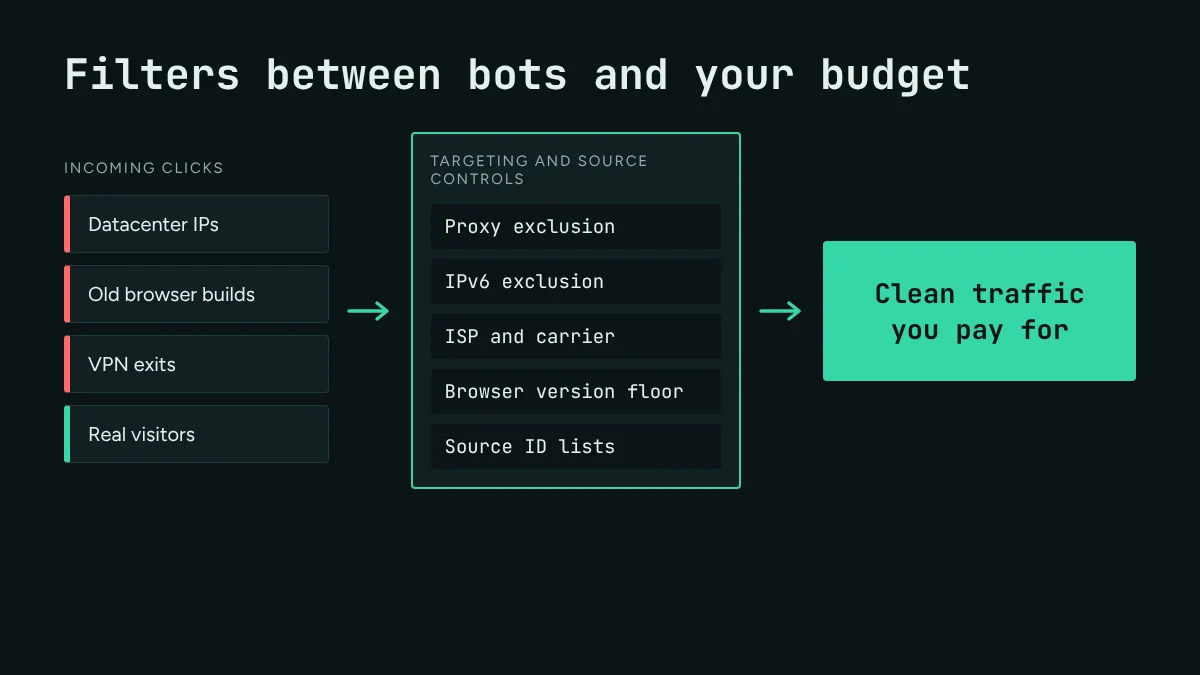
Proxy exclusion drops visitors routed through proxies, the cheapest disguise a bot operator has. I would not launch an adult campaign without it, small budget or not.
IPv6 exclusion keeps your IP-level controls working. One device on IPv6 can cycle through a huge pool of addresses, so a per-IP frequency cap and an IP blacklist stop meaning much.
Frequency capping per unique IP per day belongs in the same setup. A real visitor rarely clicks your ad again and again in one day, while a looping bot does it around the clock. A tight cap turns that loop into one paid click.
Targeting Filters That Double as Fraud Checks
Narrow targeting filters fraud as a side effect. Each setting below picks an audience and also removes a specific kind of fake visitor.
| Filter | What it catches |
|---|---|
| ISP and carrier | Server IPs posing as mobile users |
| OS and browser version | Old builds typical of bot pools |
| Connection type | Non-carrier traffic in a mobile campaign |
| Browser language | VPN exits and offshore farms |
| Dayparting with timezone | Clicks while the GEO is asleep |
| Hourly budget | One burst draining the daily budget |
Browser version targeting pays off the most. Select recent versions of the main browsers and leave old builds unchecked. You lose a few real users on neglected phones, a trade I take every time.
Source-Level Control
Source IDs are the unit that matters, because quality changes from site to site. Run-of-network buying shows you every source in the auction, while placement buying limits spend to the sources you name. Use the first to find sources and the second to pay them.
Source ID bidding and the three groups
Source ID bidding, also called micro bidding, gives each site its own price. You upload lists of source IDs before the campaign starts and attach a bid rule to each list, so a proven site gets more while an unknown one stays near the floor. After a few days of data, nearly every source fits one of three groups.
- Converting. Raise its bid and move it into a whitelist campaign.
- Cheap and silent. Little spend, no results yet. Keep it on a low-bid list while data builds.
- Expensive and silent. Real spend, zero conversions. Blacklist it, because this is where bots and popunder-only sites end up.
Blacklists and whitelists
Blacklists work on IP, ISP and source ID, and source ID does most of the work. An ISP blacklist handles one hosting provider showing up across several sources. IP blacklists age badly, because addresses change hands.
Whitelists are where a profitable campaign ends up. Run your converting source IDs in a separate campaign with their own budget so the test campaign cannot starve them.
What the Network Filters Before You Bid
Network-side checks remove obvious fraud, not all of it. On AdsCompass, every site is checked before it joins the network, bot traffic is blocked automatically, and reports show what each site delivered. That review is the first filter. Your exclusions and source lists are the second.
AdsCompass has run as an ad network and RTB exchange since 2013, and one self-serve auction reaches direct publishers and RTB supply, roughly 8 billion impressions and 60 million clicks each day across every format. At that scale, judging each source matters more than judging the network. Every control on this page sits in the dashboard at adscompass.com, where advertisers buy adult traffic from a $50 deposit.
Reading a Source Report for Waste
Sort by spend, highest first, and read from the top. A bad source in the top ten costs real money, while a bad source at row 400 costs pennies. Check three things for each high-spend source:
- Conversions, or at least tracked events, against spend.
- CTR against the campaign average, since high CTR with nothing downstream is a classic click-fraud sign.
- ISP, browser version and hour-of-day spread.
Pass source ID, IP, user agent and click ID macros to your tracker. Keitaro, Binom, Voluum and RedTrack connect to AdsCompass through S2S postback templates, so conversions group by source.
Arithmetic keeps the decision honest. Twenty dollars at $0.001 per click is 20,000 clicks, and if none of them did anything, more data will not rescue that source. Healthy sources rise and fall with the local day. A flat 24-hour line or one dominant hosting ISP points the other way.
Traffic Quality Questions
Is cheap adult traffic always low quality?
No. Adult clicks are cheap partly because Google Ads bans sexually explicit ads and Meta prohibits adult products in ads, which keeps the largest brand budgets out of these auctions. A low price is a market condition, not a fraud signal.
Should I blacklist a silent source or cut its bid?
Cut the bid when the silent source is cheap, and blacklist it when it is expensive. A cheap source has not spent enough to prove anything, so a low-bid list keeps it collecting data. An expensive one with zero conversions has already answered the question.
How soon should I add exclusions?
Before launch. Proxy and IPv6 exclusion, a per-IP frequency cap and a browser version filter belong in the first setup, because they act before the impression is bought. Source blacklists come later, once each top source has spent enough to judge.